
This post contains affiliate links. I may earn a small commission if you shop through my links, at no extra cost to you. I only share things I genuinely use and believe in. Here’s what’s actually worked for my hormonal acne after 40.
Important: I am not a dermatologist or medical professional. Everything in this post reflects my personal experience only. Please consult a doctor or dermatologist before starting any new skincare treatment or medication.
 I want to talk about something that took me a while to admit out loud.
I have been dealing with adult hormonal acne for several years. Not the occasional blemish — actual, persistent breakouts that show up right on cue with my cycle, seem to respond to whatever I throw at them, and then come back like they never left. I would find something that worked, feel hopeful for a few weeks, and then watch it return. Repeat. For years.
In the last six months, it has gotten noticeably worse. That escalation is what finally pushed me to stop managing it on my own and actually do something about it.
I am in my 40s. I was not supposed to still be doing this.
The frustrating thing about hormonal acne in your 40s is that it plays by completely different rules than the acne you dealt with as a teenager. The products that worked at 16 are often useless now. The causes are different. The skin is different. And the emotional weight of dealing with breakouts as a grown adult — when you feel like you should be past this — is its own particular kind of exhausting.
I am not on the other side of this yet. I want to be clear about that. This post isn’t a success story with a tidy ending. It’s a work in progress—what I’ve tried, what I’ve learned, what I’m currently testing, and where I’m hoping this goes. Because if you’re in the same place I’ve been, I think you deserve to know you’re not alone, and I think you deserve to read something that doesn’t pretend this is simple.
I want to talk about something that took me a while to admit out loud.
I have been dealing with adult hormonal acne for several years. Not the occasional blemish — actual, persistent breakouts that show up right on cue with my cycle, seem to respond to whatever I throw at them, and then come back like they never left. I would find something that worked, feel hopeful for a few weeks, and then watch it return. Repeat. For years.
In the last six months, it has gotten noticeably worse. That escalation is what finally pushed me to stop managing it on my own and actually do something about it.
I am in my 40s. I was not supposed to still be doing this.
The frustrating thing about hormonal acne in your 40s is that it plays by completely different rules than the acne you dealt with as a teenager. The products that worked at 16 are often useless now. The causes are different. The skin is different. And the emotional weight of dealing with breakouts as a grown adult — when you feel like you should be past this — is its own particular kind of exhausting.
I am not on the other side of this yet. I want to be clear about that. This post isn’t a success story with a tidy ending. It’s a work in progress—what I’ve tried, what I’ve learned, what I’m currently testing, and where I’m hoping this goes. Because if you’re in the same place I’ve been, I think you deserve to know you’re not alone, and I think you deserve to read something that doesn’t pretend this is simple.
 This might seem like an odd place to start, but hear me out: I wanted a clean, single-use option instead of wondering how recently a shared bathroom towel had been washed.
I switched to disposable face towels and it was one of the easiest, least dramatic changes I made. These are large, soft, thick, and fully biobased so the environmental footprint concern is addressed. They’re not a treatment — they’re just a smarter habit, and for acne-prone skin, habits matter.
This might seem like an odd place to start, but hear me out: I wanted a clean, single-use option instead of wondering how recently a shared bathroom towel had been washed.
I switched to disposable face towels and it was one of the easiest, least dramatic changes I made. These are large, soft, thick, and fully biobased so the environmental footprint concern is addressed. They’re not a treatment — they’re just a smarter habit, and for acne-prone skin, habits matter.
 Salicylic acid is a BHA (beta hydroxy acid) that works by getting inside the pore and dissolving the debris that causes congestion and breakouts. Unlike physical scrubs that can irritate already-inflamed skin, a well-formulated salicylic acid solution does the work without the trauma.
Paula’s Choice CLEAR Anti-Redness Exfoliating Solution is one I’ve heard praised repeatedly in serious skincare circles, and having used it, I understand why. It’s fragrance-free, it doesn’t sting or irritate, and it addresses both the acne and the redness that comes with it. I use this after cleansing, before serum.
Salicylic acid is a BHA (beta hydroxy acid) that works by getting inside the pore and dissolving the debris that causes congestion and breakouts. Unlike physical scrubs that can irritate already-inflamed skin, a well-formulated salicylic acid solution does the work without the trauma.
Paula’s Choice CLEAR Anti-Redness Exfoliating Solution is one I’ve heard praised repeatedly in serious skincare circles, and having used it, I understand why. It’s fragrance-free, it doesn’t sting or irritate, and it addresses both the acne and the redness that comes with it. I use this after cleansing, before serum.
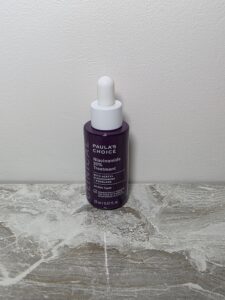 Niacinamide — also called Vitamin B3 — is one of the most well-researched ingredients in skincare. It is an ingredient commonly used in products aimed at the appearance of pores, uneven tone, and oiliness. I use this serum as part of my routine for post-breakout marks and overall texture.
The Paula’s Choice formula contains 20% niacinamide, so I use a small amount. Higher percentages can be irritating for some people, making slow introduction and patch testing sensible.
Niacinamide — also called Vitamin B3 — is one of the most well-researched ingredients in skincare. It is an ingredient commonly used in products aimed at the appearance of pores, uneven tone, and oiliness. I use this serum as part of my routine for post-breakout marks and overall texture.
The Paula’s Choice formula contains 20% niacinamide, so I use a small amount. Higher percentages can be irritating for some people, making slow introduction and patch testing sensible.
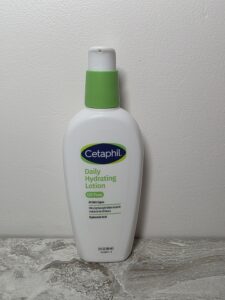 One of the counterintuitive things about acne-prone skin is that it still needs moisture. Trying to dry out every breakout left my skin feeling uncomfortable. My goal now is to maintain hydration with a lightweight formula that works for my skin.
The Cetaphil Daily Hydrating Lotion is lightweight, non-comedogenic (meaning it won’t clog pores), fragrance-free, and provides 24-hour hydration through hyaluronic acid. It’s the kind of no-drama moisturizer that just works. Dermatologist-recommended, which aligns with the whole “let’s be medically thoughtful about this” approach I’m taking right now.
One of the counterintuitive things about acne-prone skin is that it still needs moisture. Trying to dry out every breakout left my skin feeling uncomfortable. My goal now is to maintain hydration with a lightweight formula that works for my skin.
The Cetaphil Daily Hydrating Lotion is lightweight, non-comedogenic (meaning it won’t clog pores), fragrance-free, and provides 24-hour hydration through hyaluronic acid. It’s the kind of no-drama moisturizer that just works. Dermatologist-recommended, which aligns with the whole “let’s be medically thoughtful about this” approach I’m taking right now.
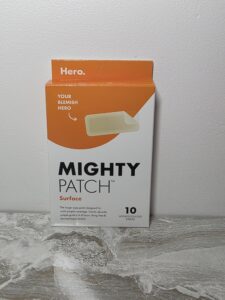 Pimple patches have become a genuine skincare category, and for good reason: hydrocolloid technology actually works. Hydrocolloid patches can absorb fluid from surface-level blemishes and, just as importantly for me, keep my hands away from the area.
The Mighty Patch Surface patches are the large-format version specifically designed for surface-level blemishes on the cheeks, forehead, and chin — which is exactly where hormonal acne tends to show up. I keep these on my nightstand and reach for them the moment I feel something coming up.
Pimple patches have become a genuine skincare category, and for good reason: hydrocolloid technology actually works. Hydrocolloid patches can absorb fluid from surface-level blemishes and, just as importantly for me, keep my hands away from the area.
The Mighty Patch Surface patches are the large-format version specifically designed for surface-level blemishes on the cheeks, forehead, and chin — which is exactly where hormonal acne tends to show up. I keep these on my nightstand and reach for them the moment I feel something coming up.
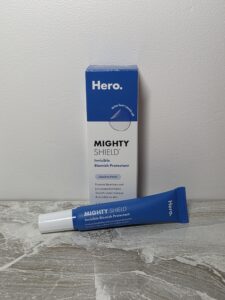 The daytime companion to the Mighty Patch. This liquid formula dries invisible and creates a protective barrier over active blemishes — shielding them from makeup, sunscreen, and environmental irritants throughout the day. When you have a spot you need to cover with makeup, this goes on first. It protects the healing process while letting you live your life.
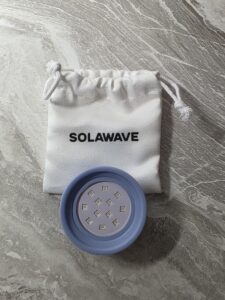 Blue light therapy for acne isn’t new — it’s been used in dermatology offices for years. Some blue-light devices are marketed to target acne-associated bacteria, but evidence and device quality vary, especially for at-home products. I treat this as an optional experiment rather than a substitute for dermatology care.
The Solawave device brings that technology into an at-home format. I have been using it consistently for a short time—not long enough to report results with any real confidence. What I can tell you is that it’s easy to use, it’s not uncomfortable, and the rationale for adding it to my routine makes sense given what I understand about how hormonal acne works.
I’m going to keep using it and I’ll update this post as I have more to report. For now, consider this a “currently testing” note rather than an endorsement. I need more time before drawing any conclusion.
Blue light therapy for acne isn’t new — it’s been used in dermatology offices for years. Some blue-light devices are marketed to target acne-associated bacteria, but evidence and device quality vary, especially for at-home products. I treat this as an optional experiment rather than a substitute for dermatology care.
The Solawave device brings that technology into an at-home format. I have been using it consistently for a short time—not long enough to report results with any real confidence. What I can tell you is that it’s easy to use, it’s not uncomfortable, and the rationale for adding it to my routine makes sense given what I understand about how hormonal acne works.
I’m going to keep using it and I’ll update this post as I have more to report. For now, consider this a “currently testing” note rather than an endorsement. I need more time before drawing any conclusion.
I want to talk about something that took me a while to admit out loud.
I have been dealing with adult hormonal acne for several years. Not the occasional blemish — actual, persistent breakouts that show up right on cue with my cycle, seem to respond to whatever I throw at them, and then come back like they never left. I would find something that worked, feel hopeful for a few weeks, and then watch it return. Repeat. For years.
In the last six months, it has gotten noticeably worse. That escalation is what finally pushed me to stop managing it on my own and actually do something about it.
I am in my 40s. I was not supposed to still be doing this.
The frustrating thing about hormonal acne in your 40s is that it plays by completely different rules than the acne you dealt with as a teenager. The products that worked at 16 are often useless now. The causes are different. The skin is different. And the emotional weight of dealing with breakouts as a grown adult — when you feel like you should be past this — is its own particular kind of exhausting.
I am not on the other side of this yet. I want to be clear about that. This post isn’t a success story with a tidy ending. It’s a work in progress—what I’ve tried, what I’ve learned, what I’m currently testing, and where I’m hoping this goes. Because if you’re in the same place I’ve been, I think you deserve to know you’re not alone, and I think you deserve to read something that doesn’t pretend this is simple.
Hormonal Acne After 40: Why Is This Happening?
This was the first question I needed answered: why now — or more accurately in my case, why is something I’ve managed for years suddenly getting worse? The short answer is hormones — specifically, the hormonal shifts that come with perimenopause. As estrogen levels begin to fluctuate and decline, androgens (the hormones responsible for oil production) can become relatively more dominant. More oil production means more clogged pores. More clogged pores means more breakouts. Add stress, lifestyle, and the natural changes in how our skin renews itself as we age, and you have the perfect conditions for adult hormonal acne. For me, the pattern is unmistakable: my breakouts are completely tied to my cycle. They flare up predictably every month — same timing, same location, like clockwork. If that sounds familiar to you, that cyclical pattern is actually one of the clearest signs that what you’re dealing with is hormonal acne specifically, not just general adult acne. The distinction matters because it changes how you treat it. The classic presentation is breakouts that cluster around the lower face — the jawline, chin, and sometimes the cheeks — that track with your cycle and respond temporarily to treatment before returning. If you’ve been nodding along to any of this: you are not imagining it, and you are not alone. This is a real and common experience for women in their 40s, and it is woefully underrepresented in skincare content. Understanding the why was actually the thing that helped me stop blaming myself — and my skincare routine — and start approaching this more strategically.I Finally Went to the Dermatologist
After years of managing this on my own — and watching it get progressively worse over the last six months — I finally made an appointment with a dermatologist. The escalation was the tipping point. When something that had been manageable starts becoming noticeably harder to manage, that’s the signal. It was the right call and I wish I had done it sooner. My dermatologist prescribed Spironolactone, which is a medication I had actually used before with real success. My dermatologist explained that spironolactone can reduce the effect of androgens that contribute to acne in some women. It is not an overnight treatment, and results can take months. I’m following my dermatologist’s instructions and monitoring how my skin responds. I’ve been on it for about a week now. My current flare-up has settled down a little, which is something, but it’s still definitely there. I’m under no illusion that this is resolved. What I do feel for the first time in a year is like I have an actual plan — a medical one, not just another product I found on the internet and am hoping for the best. I cannot recommend strongly enough: if you have been dealing with persistent hormonal acne for an extended period, please see a dermatologist. There are prescription options that simply aren’t available over the counter, and a professional can assess what’s actually happening with your skin in a way that no amount of skincare research can replicate.The Routine I’m Currently Building
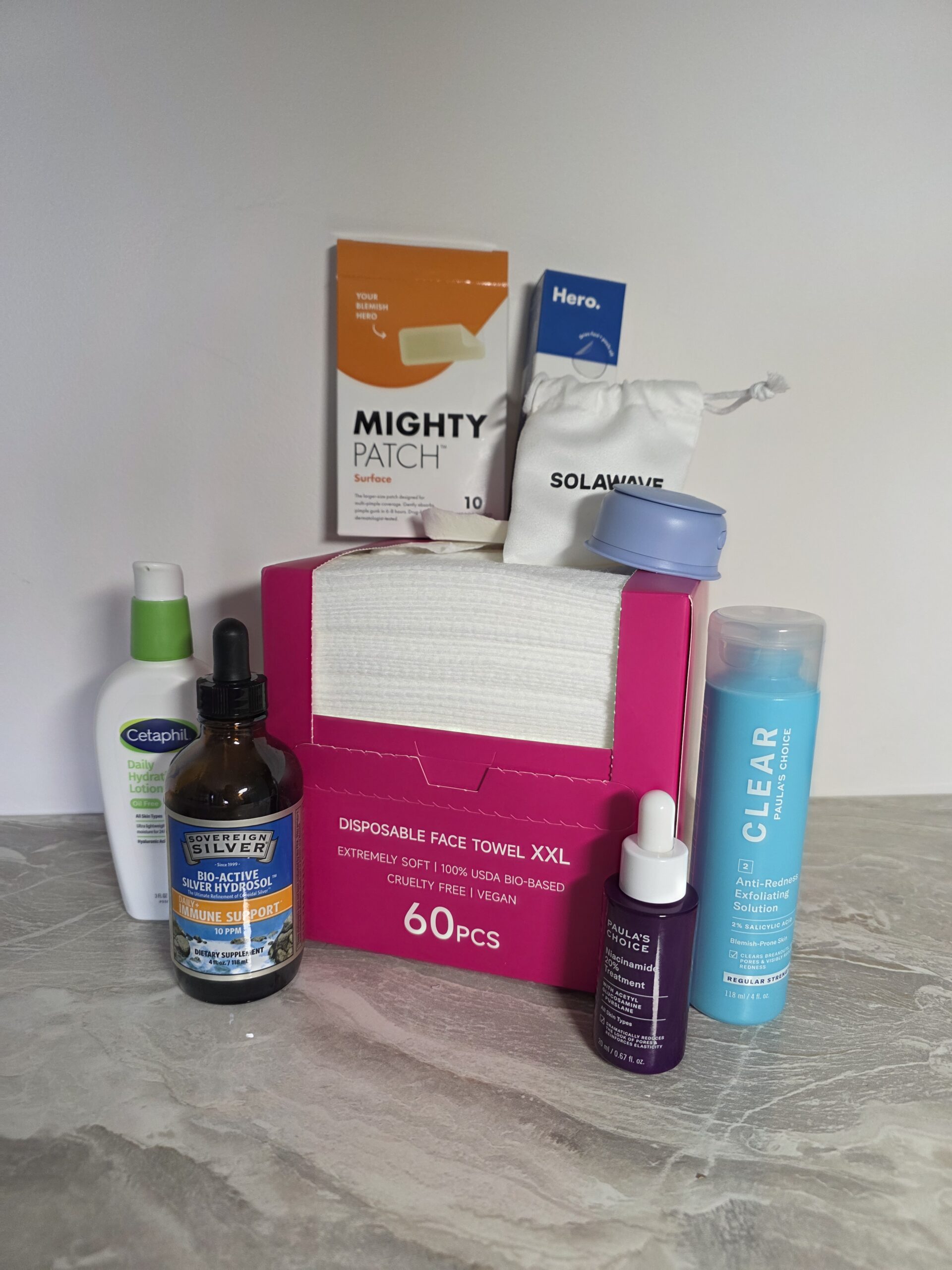
Alongside the Spironolactone, I have been carefully rebuilding my skincare routine with products specifically chosen for acne-prone skin. Here is everything I’m currently using, and why each piece earned its place.Step 1: Disposable Face Towels — FACEMADE XXL Biobased Disposable Face Towels
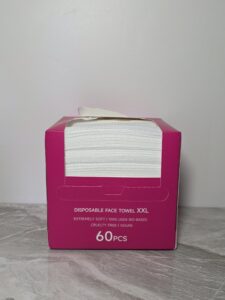
This might seem like an odd place to start, but hear me out: I wanted a clean, single-use option instead of wondering how recently a shared bathroom towel had been washed.
I switched to disposable face towels and it was one of the easiest, least dramatic changes I made. These are large, soft, thick, and fully biobased so the environmental footprint concern is addressed. They’re not a treatment — they’re just a smarter habit, and for acne-prone skin, habits matter.
- FACEMADE 60 Count XXL Disposable Face Towels, 12″ x 12″, 100% Biobased https://amzn.to/4g1Ex7s
Step 2: Chemical Exfoliant — Paula’s Choice CLEAR 2% Salicylic Acid
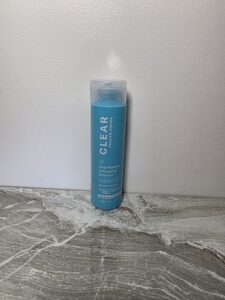
Salicylic acid is a BHA (beta hydroxy acid) that works by getting inside the pore and dissolving the debris that causes congestion and breakouts. Unlike physical scrubs that can irritate already-inflamed skin, a well-formulated salicylic acid solution does the work without the trauma.
Paula’s Choice CLEAR Anti-Redness Exfoliating Solution is one I’ve heard praised repeatedly in serious skincare circles, and having used it, I understand why. It’s fragrance-free, it doesn’t sting or irritate, and it addresses both the acne and the redness that comes with it. I use this after cleansing, before serum.
- Paula’s Choice CLEAR Anti-Redness Exfoliating Solution, 2% Salicylic Acid https://amzn.to/43ON0Ud
Step 3: Treatment Serum — Paula’s Choice CLINICAL 20% Niacinamide Serum
Niacinamide — also called Vitamin B3 — is one of the most well-researched ingredients in skincare. It is an ingredient commonly used in products aimed at the appearance of pores, uneven tone, and oiliness. I use this serum as part of my routine for post-breakout marks and overall texture.
The Paula’s Choice formula contains 20% niacinamide, so I use a small amount. Higher percentages can be irritating for some people, making slow introduction and patch testing sensible.
- Paula’s Choice CLINICAL 20% Niacinamide Vitamin B3 Concentrated Face Serum https://amzn.to/3Q4YJuG
Step 4: Moisturizer — Cetaphil Daily Hydrating Lotion with Hyaluronic Acid
One of the counterintuitive things about acne-prone skin is that it still needs moisture. Trying to dry out every breakout left my skin feeling uncomfortable. My goal now is to maintain hydration with a lightweight formula that works for my skin.
The Cetaphil Daily Hydrating Lotion is lightweight, non-comedogenic (meaning it won’t clog pores), fragrance-free, and provides 24-hour hydration through hyaluronic acid. It’s the kind of no-drama moisturizer that just works. Dermatologist-recommended, which aligns with the whole “let’s be medically thoughtful about this” approach I’m taking right now.
- Cetaphil Daily Hydrating Lotion for Face, Hyaluronic Acid, 3 fl oz https://amzn.to/4uTReWF
Step 5: Spot Treatment — Mighty Patch Surface Large Pimple Patches
Pimple patches have become a genuine skincare category, and for good reason: hydrocolloid technology actually works. Hydrocolloid patches can absorb fluid from surface-level blemishes and, just as importantly for me, keep my hands away from the area.
The Mighty Patch Surface patches are the large-format version specifically designed for surface-level blemishes on the cheeks, forehead, and chin — which is exactly where hormonal acne tends to show up. I keep these on my nightstand and reach for them the moment I feel something coming up.
- Mighty Patch Surface Large Pimple Patches for Face, 10 Count — Hero Cosmetics https://amzn.to/3Slj3bM
Step 6: Daytime Protection — Mighty Shield Liquid Patch Invisible Blemish Protectant
The daytime companion to the Mighty Patch. This liquid formula dries invisible and creates a protective barrier over active blemishes — shielding them from makeup, sunscreen, and environmental irritants throughout the day. When you have a spot you need to cover with makeup, this goes on first. It protects the healing process while letting you live your life.
- HERO COSMETICS Mighty Shield Liquid Patch Invisible Blemish Protectant https://amzn.to/4vauodD
What I’m Testing: The Solawave Blue Light Device
Blue light therapy for acne isn’t new — it’s been used in dermatology offices for years. Some blue-light devices are marketed to target acne-associated bacteria, but evidence and device quality vary, especially for at-home products. I treat this as an optional experiment rather than a substitute for dermatology care.
The Solawave device brings that technology into an at-home format. I have been using it consistently for a short time—not long enough to report results with any real confidence. What I can tell you is that it’s easy to use, it’s not uncomfortable, and the rationale for adding it to my routine makes sense given what I understand about how hormonal acne works.
I’m going to keep using it and I’ll update this post as I have more to report. For now, consider this a “currently testing” note rather than an endorsement. I need more time before drawing any conclusion.
- Solawave Blue Light Acne Treatment Device https://amzn.to/4ahjytF
What I’ve Actually Learned From a Year of This
A year is a long time to deal with something that keeps coming back. Here’s what I’ve genuinely taken away from it:- Hormonal acne after 40 is different from teenage acne and needs to be treated differently. Products aimed at teenagers are often too harsh, too drying, and don’t address the hormonal root cause.
- The “I think it’s working” phase is real — and so is the return. Managing your expectations through that cycle is genuinely hard but necessary.
- Hygiene habits matter more than most people realize. Clean pillowcases. Clean towels. Hands off your face. These are not glamorous interventions but they are real ones.
- Seeing a dermatologist was the thing I should have done in month two, not month twelve. If you’re reading this and you’ve been dealing with persistent breakouts for a while, go. Make the appointment.
- Being gentle with yourself through this is part of the process. Acne at any age can affect your confidence in ways that are disproportionate to the actual size of the blemish. You’re not vain for caring about this. You’re human.

2 Responses